
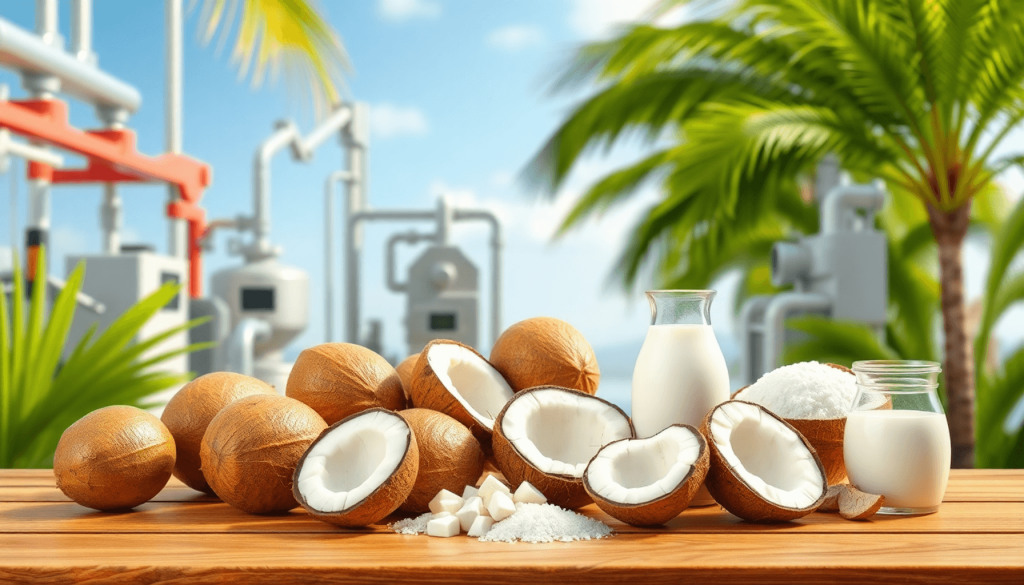
The coconut industry in Indonesia has great potential. It is an important commodity with various uses. However, there are challenges such as labor intensity and inefficient processing methods.
The industry’s growth can be attributed to:
- Value-added products: Opportunities exist for coconut oil, milk, sugar, and charcoal.
- Export expansion: Demand for coconut derivatives continues to rise globally.
Technology plays a crucial role in improving the quality and value of coconut products. By incorporating modern solutions into processing methods, producers can achieve:
- Improved efficiency
- Consistent product quality
- Enhanced market competitiveness
Using these technologies will not only solve existing problems but also create new opportunities in the coconut sector, benefiting both producers and consumers.
Read More: Innovation Of Eco-Friendly Packaging For Coconut Derivative Products.
Technological Innovations in Coconut Processing
The coconut industry benefits significantly from farm mechanization through the introduction of automated machines. These innovations include:
- Automated de-husking machines: Streamline the removal of husks, drastically reducing processing time.
- Peeling machines: Enhance efficiency by minimizing manual labor involved in peeling coconuts.
- Grading systems: Ensure uniformity in product quality, allowing for better market positioning.
Such technologies not only facilitate labor reduction but also increase overall efficiency in coconut processing. The shift towards automation helps producers meet growing demand while maintaining high standards of quality. Embracing these technological advancements leads to a more sustainable and profitable coconut industry. The integration of automated solutions paves the way for improved productivity, ultimately enhancing the value of coconut products in an increasingly competitive market.
Precision Agriculture in Coconut Farming
The integration of drones and satellite technology is transforming coconut farming, enabling precise crop monitoring and effective disease detection. This technological advancement offers several benefits:
- Real-time Data Collection: Drones equipped with high-resolution cameras capture images of coconut plantations, allowing farmers to assess crop health accurately.
- Early Disease Detection: Satellite imagery helps identify areas affected by diseases or pests, facilitating timely intervention and reducing crop loss.
- Resource Optimization: By analyzing data gathered from aerial views, farmers can optimize irrigation and nutrient application, ensuring healthy growth while minimizing waste.
Utilizing these tools not only increases efficiency but also enhances decision-making, ultimately leading to higher yields. Embracing precision agriculture empowers coconut producers to address challenges in cultivation while improving the overall quality of their products.
Advanced Drying Techniques for Coconut Products
The quality and added value of coconut products can significantly benefit from advanced drying techniques. Two prominent methods are hot air drying and freeze drying.
1. Hot Air Drying
This technique utilizes heated air to remove moisture from coconut products. It effectively preserves flavors and enhances shelf life, making it a popular choice for desiccated coconut and coconut chips.
2. Freeze Drying
In contrast, freeze drying involves freezing the product first and then removing moisture in a vacuum. This method retains the nutritional value and flavor better than traditional drying methods, crucial for products like coconut milk powder and snacks.
Both techniques play a vital role in ensuring that the nutritional integrity of coconuts is maintained while enhancing the overall quality of the final product. As producers seek to elevate their offerings, these innovative approaches to drying are essential for meeting market demands.
UHT Technology in Coconut Water Preservation
Tetra Pak’s Direct Ultra-High Temperature (UHT) technology plays a crucial role in preserving coconut water. This method involves heating coconut water to high temperatures for a brief period, effectively eliminating harmful microorganisms while maintaining its natural flavor and nutrients.
Benefits of UHT Technology:
- Extended Shelf Life: UHT processing significantly increases the shelf life of coconut water without the need for refrigeration.
- Nutrient Retention: The rapid heating and cooling process helps preserve essential vitamins and minerals, ensuring that consumers receive a nutritious product.
- Flavor Integrity: Coconut water’s natural taste is largely untouched, providing an authentic experience for consumers.
By adopting Tetra Pak’s UHT technology, producers can enhance the quality of coconut water offerings. This advancement not only meets consumer demand for fresh-tasting beverages but also supports the sustainability of the coconut industry as a whole.
Improving Quality Control with Technology in Coconut Processing
Ensuring color consistency in desiccated coconut is crucial for both aesthetic appeal and marketability. Digital colorimeters play a vital role in this process by providing precise measurements of color attributes.
Key benefits include:
- Consistency: Automated color measurement reduces human error, ensuring uniformity across batches.
- Quality Assurance: Regular monitoring allows producers to meet quality standards, enhancing product appeal.
- Faster Feedback: Immediate results facilitate quick adjustments during production, optimizing the final product.
By implementing digital colorimeters, coconut processors can maintain high standards of quality control. Enhanced color consistency not only satisfies consumer expectations but also strengthens brand reputation in a competitive market. This technology directly contributes to elevating the overall quality and value of coconut products.
NIR Technology for Contamination Detection in Coconut Products
Near-Infrared Spectroscopy (NIR) is changing the coconut industry by providing fast and accurate analysis of chemical composition. This technology is essential for identifying contaminants in coconut products, ensuring safety and quality for consumers.
Key advantages of NIR technology include:
- Speed: Immediate results allow for quick decision-making in processing.
- Non-destructive testing: Preserves product integrity during analysis.
- Comprehensive data: Offers insights into moisture, fat, and protein levels alongside contamination detection.
Implementing NIR technology can significantly enhance quality control measures, reducing risks associated with contaminated products. By ensuring that only the highest quality coconut products reach consumers, this innovative approach adds substantial value to the industry. The use of technology to improve the quality and added value of coconut products is evident through advancements like NIR, promoting both safety and efficiency in production processes.
AI and Machine Learning for Quality Inspection in Coconut Processing
The integration of AI and Machine Learning technologies has significantly enhanced quality inspection processes in coconut processing. These advancements allow for:
- Automated Detection: Utilizing image recognition algorithms, AI can identify defects and imperfections in coconut products with remarkable accuracy.
- Real-time Analysis: Machine learning models continuously learn from data, improving their ability to detect subtle quality variations over time.
- Cost Efficiency: Reducing human error not only minimizes waste but also enhances productivity, leading to higher profit margins for producers.
Adopting these technologies results in a more reliable quality assurance process. With precise detection capabilities, businesses can maintain high standards, ensuring that only top-tier products reach consumers. As the coconut industry seeks to compete globally, investing in AI-driven solutions will prove essential for maintaining product integrity and satisfying market demands. The ongoing evolution of technology promises further innovations that will continue to elevate quality inspection standards in the sector.
Ralali’s Role in Supporting Coconut Product Innovation
Ralali plays a crucial role in the coconut industry by connecting coconut producers with manufacturers through the Ralali Marketplace, a leading B2B platform in Indonesia. This platform facilitates:
- Streamlined Supply Chains: Producers can easily find manufacturers for their coconut products, enhancing efficiency and reducing time delays.
- Access to Resources: Ralali provides essential services, including procurement, funding, and distribution, which are crucial for small and medium enterprises (MSMEs) in the coconut sector.
- Collaboration Opportunities: By fostering partnerships among stakeholders, Ralali encourages innovation in coconut derivatives, such as activated charcoal from shells and electrolyte beverages from coconut water.
Through these initiatives, Ralali not only supports the growth of the coconut industry but also contributes to a sustainable business ecosystem that empowers local producers.
Ralali Plus: Financial Solutions for Innovative Processing Technologies in the Coconut Industry
Ralali Plus offers tailored financial solutions designed to support businesses investing in innovative processing technologies within the coconut industry. This initiative focuses on empowering companies to enhance the quality and added value of coconut products through:
- Access to funding: Flexible financing options enable businesses to acquire advanced equipment and technology.
- Investment in research and development: Encouragement for companies to explore new processing methods that elevate product standards.
- Support for scaling operations: Financial backing helps enterprises expand their production capabilities.
By facilitating investments in state-of-the-art technologies, Ralali Plus plays a crucial role in transforming the coconut sector. This support not only boosts productivity and efficiency but also drives sustainability efforts in processing practices. The integration of innovative technologies ensures that businesses can meet market demands while maintaining high-quality standards for coconut-derived products.
Ralali Pavilion: Showcasing Innovation in Coconut Derivatives
The Ralali Pavilion serves as a dynamic platform for showcasing innovation within the coconut industry. It highlights cutting-edge products and solutions that enhance the value of coconut derivatives, attracting attention from producers and consumers alike. Key features include:
- Product Exhibitions: Display of innovative coconut-based products such as activated charcoal, coconut water electrolyte beverages, and more.
- Networking Opportunities: Facilitates connections between stakeholders, including manufacturers, suppliers, and researchers.
- Workshops and Seminars: Educational sessions promoting best practices and latest technologies in coconut processing.
The pavilion not only promotes the diverse applications of coconuts but also emphasizes sustainable practices. By fostering collaboration, the Ralali Pavilion plays a crucial role in driving growth and innovation across the coconut sector. This initiative aligns with Ralali’s mission to empower producers while enhancing market competitiveness.
Market Access Technologies for Coconut Farmers
Digital platforms have transformed the way coconut farmers connect with markets. These platforms facilitate direct access to buyers, streamlining the sales process and enhancing profitability. Key benefits include:
- Real-time information: Farmers receive instant updates on market demand, allowing them to adjust their production strategies accordingly.
- Increased visibility: Digital tools enable farmers to showcase their products to a wider audience, expanding their reach beyond local markets.
- Data-driven decisions: With access to market trends and pricing data, farmers can make informed choices about when and how much to sell.
This technology not only empowers farmers but also promotes better resource management. By linking producers with consumers, digital platforms enhance the overall efficiency of the coconut supply chain. As a result, these innovations have a significant impact on the livelihoods of coconut farmers and contribute to the growth of the industry.
Traceability Solutions Using Blockchain Technology in the Coconut Supply Chain
Blockchain technology offers revolutionary solutions for supply chain transparency in the coconut industry. By employing this technology, stakeholders can achieve:
- Enhanced Traceability: Each transaction is recorded on a decentralized ledger, providing an immutable history of product movement from farm to consumer.
- QR Codes: Consumers can scan QR codes on coconut products to access detailed information about sourcing, processing, and quality checks.
The integration of blockchain not only builds trust among consumers but also empowers producers. You gain insights into market demands and consumer preferences through transparent data sharing.
This level of transparency is essential for maintaining high-quality standards, ensuring that coconut products meet consumer expectations. As the industry continues to evolve, adopting such innovative technologies will further strengthen the value chain and enhance the quality of coconut products.
Sustainable Practices in the Coconut Industry: Waste Utilization and Energy Conversion Technologies
The coconut industry has a significant opportunity to enhance sustainability through innovative practices. By adopting a circular economy approach, businesses can effectively minimize waste while adding value to their operations.
Key Strategies for Sustainable Practices
1. Utilizing By-products
Every part of the coconut can be repurposed. For example, coconut husks can be transformed into coir fibers, used in horticulture and erosion control. Coconut shells are increasingly being utilized to produce activated charcoal, which has applications in air and water purification.
2. Energy Conversion Technologies
Systems like BioCNG are revolutionizing how waste products are managed. These systems convert organic waste, including coconut water and pulp, into renewable energy. The generated biogas can be used for cooking or as fuel for vehicles, significantly reducing dependency on fossil fuels.
Benefits of Implementing Sustainable Practices
1. Waste Minimization
Reducing the volume of waste sent to landfills lowers environmental impact. This aligns with global sustainability goals and enhances the brand image of coconut producers.
2. Economic Gains
Utilizing by-products creates additional revenue streams. Companies that invest in renewable energy systems often see long-term cost savings.
By integrating these technologies and sustainable practices, the coconut industry not only improves its environmental footprint but also enhances the quality and added value of coconut products. Embracing such innovations positions businesses favorably within an increasingly eco-conscious market.
FAQs (Frequently Asked Questions)
Technology is crucial in the coconut industry as it enhances the quality and added value of coconut products. Innovations such as automated machines, precision agriculture, and advanced drying techniques help improve production efficiency and product quality.
Drones and satellite technology facilitate crop monitoring and disease detection in coconut farming. These tools allow farmers to assess crop health more accurately, leading to better management practices and increased yields.
Advanced drying techniques include hot air drying and freeze-drying, which are employed to preserve the nutritional value and flavor of coconut products. These methods ensure that the quality of the product remains high during processing.
Tetra Pak’s Direct Ultra-High Temperature (UHT) technology is used to preserve coconut water while maintaining its natural flavor and nutrients. This method allows for longer shelf life without compromising quality.
Pingback:Innovation Of Eco-Friendly Packaging For Coconut Derivative Products. - Indonesia Supplier