
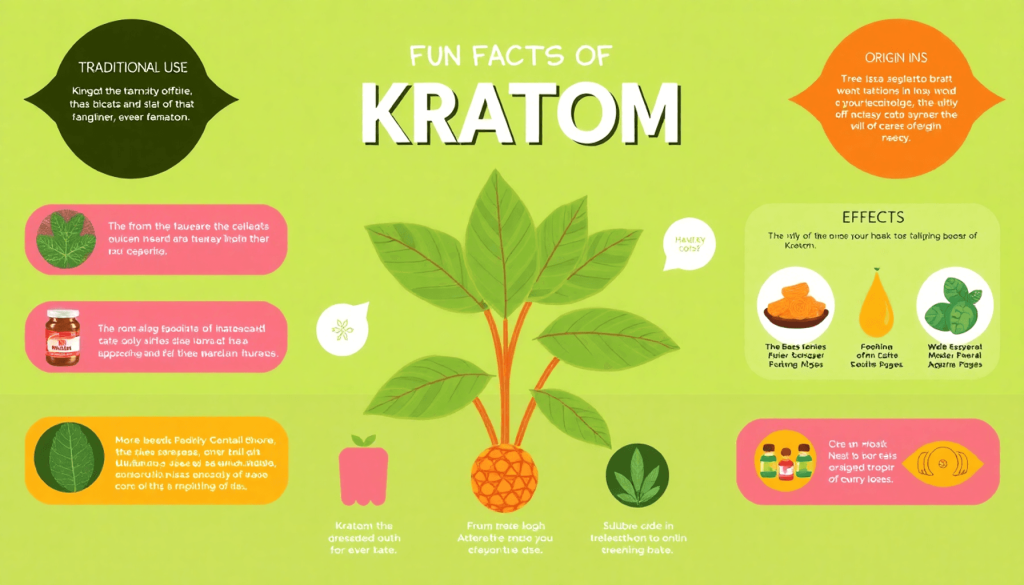
Kratom (Mitragyna speciosa) is a tropical tree native to Southeast Asia that has captivated global attention for its fascinating properties and diverse applications. This remarkable plant transcends its botanical classification to embody centuries of cultural tradition, medicinal innovation, and socioeconomic significance. From the dense forests of Thailand to specialty shops worldwide, kratom’s journey represents a compelling intersection of ancient wisdom and modern curiosity.
As we explore kratom’s multifaceted nature, we’ll discover how this unassuming tree has influenced societies, economies, and scientific research across continents and generations. Its story reveals the complex relationship between humans and plants that continues to evolve in our rapidly changing world.
Botanical Characteristics
Family Connections and Physical Traits
Kratom belongs to the Rubiaceae family, the same plant family as coffee. Unlike coffee beans, kratom leaves contain over 40 alkaloids, including mitragynine and 7-hydroxymitragynine, which influence its stimulant and sedative effects depending on the dosage. The tree can grow up to 25 meters (82 feet) tall with a trunk diameter of up to 0.9 meters (3 feet), featuring large, glossy dark green leaves that are harvested for their alkaloid-rich content.
Flowers and Growth Patterns
Kratom’s flowers are cream-colored and grow in dense spherical clusters at the ends of branches. While these small flowers contribute to the plant’s reproduction and ecological role in tropical environments, they are not commonly harvested or used for consumption or trade. The kratom tree can reach impressive heights of up to 50 feet (15 meters) with a spread of more than 15 feet, making it a substantial presence in Southeast Asian forests.
Leaf Characteristics
Kratom leaves are ovate-acuminate in shape with 12 to 17 pairs of veins, growing to over 14-20 cm long and 7-12 cm wide, with a glossy dark green upper surface. The color of kratom leaf veins—red, green, or white—indicates its effects: red-veined leaves (younger) are typically relaxing, white-veined leaves (mature) are stimulating, and green-veined leaves offer a balance between the two.
Historical and Traditional Use
Ancient Energy Source
For centuries, laborers in Thailand and Malaysia chewed kratom leaves to boost energy during long hours of hard physical work. Farmers and laborers also brewed the leaves into tea to combat fatigue and increase productivity during long workdays—a practice that remains popular among farmers today. Beyond tea preparation, traditional users would often chew fresh kratom leaves to release the active compounds more directly, a practice still common in rural areas of Southeast Asia.
Medicinal Applications
In the 19th century, kratom was widely used as an opium substitute in Southeast Asia, helping chronic opium users manage withdrawal symptoms—a historical use that highlights its cultural importance. In 1943, Thailand introduced a tax on kratom leaves to control its use as an alternative to opium, which eventually led to its prohibition in the country until it was decriminalized in 2021.
Cultural Significance
Linguistic Diversity
Kratom is known by various names across cultures: ketum (Malaysia), biak-biak (Indonesia), thang (Thailand), and kakuam (Cambodia). This linguistic diversity reflects its widespread use and cultural integration throughout Southeast Asia, with each name carrying its own cultural connotations and historical context.
Consumption Rituals
In Thailand, kratom was traditionally used as a snack to receive guests and was part of the ritual worship of ancestors and gods, showing its deep cultural integration beyond medicinal use. These ceremonial applications demonstrate how kratom served as both a social lubricant and spiritual tool in traditional Southeast Asian societies.
Modern Cultural Adaptations
Contemporary Consumption Methods
While traditionally brewed into tea, kratom has found its way into modern beverages like “4×100,” a cocktail popular among youth in Thailand that mixes kratom leaves with cough syrup, Coca-Cola, and ice. This adaptation reflects how traditional substances evolve with changing lifestyles and generational preferences.
Global Spread and Commercialization
In some states in the U.S., kratom is sold as a drink called ketum in bars—a modern twist on its traditional consumption methods. As of 2020, an estimated 15 million Americans were using kratom for various purposes—from pain relief to recreational use—highlighting its growing global presence beyond its traditional contexts.
Scientific Properties and Effects
Dual Nature of Effects
At low doses, kratom acts as a stimulant, increasing alertness, energy, and sociability; at higher doses, it produces sedative effects similar to opioids, providing relaxation and pain relief. This dual nature makes it unique among psychoactive plants and explains its versatility in traditional and modern applications.
Chemical Composition
The primary active compound in kratom is mitragynine, which interacts with opioid receptors but doesn’t produce respiratory depression like traditional opioids—a fact that intrigues researchers. Kratom contains over 40 different alkaloids, making it chemically complex and difficult to categorize as just one type of drug (like a stimulant or opioid).
Scientific Documentation
Botanical Classification
Kratom was first formally described by Dutch colonial botanist Pieter Korthals in 1839 as Stephegyne speciosa before being renamed and reclassified several times. George Darby Haviland provided its final name and classification in 1859. This scientific documentation marked kratom’s introduction to Western knowledge systems and began its journey into global awareness.
Legal Status and Economic Impact
Regulatory Variations
Kratom’s legal status varies widely across the globe. It is banned or regulated in several countries, including Australia, Malaysia, and some European nations. In the U.S., its legality varies by state, where it remains legal in many states and is sold as a dietary supplement. In 2021, Thailand decriminalized kratom after decades of prohibition, marking a significant shift in policy for one of the plant’s native countries.
Agricultural Significance
Kratom cultivation provides income for small-scale farmers across Southeast Asia, creating economic opportunities in regions with limited resources. Unlike destructive monoculture crops like palm oil plantations that harm ecosystems, kratom trees can be grown alongside other plants in agroforestry systems that preserve soil quality and support local biodiversity.
Conclusion
Kratom represents far more than just another botanical curiosity—it embodies the complex relationship between humans and plants that spans centuries and continents. From its humble origins in the forests of Southeast Asia to its controversial presence in global markets, kratom continues to challenge our understanding of traditional plant medicines in a modern context.
The story of kratom reminds us that plants have always played multifaceted roles in human societies: as medicines, cultural symbols, economic resources, and subjects of scientific inquiry. As research continues and regulatory landscapes evolve, kratom stands at the intersection of tradition and innovation, inviting us to consider how ancient plant knowledge can inform contemporary approaches to health, culture, and environmental sustainability.
Whether viewed as a traditional remedy, a controversial substance, or an economic opportunity, kratom’s rich history and complex properties ensure its continued significance in conversations about ethnobotany, traditional knowledge, and the global exchange of plant resources. As we navigate these discussions, the fascinating facts about kratom serve as reminders of the profound connections between human cultures and the plant world that sustains them.
Pingback:Kratom-Producing Regions in Indonesia - Indonesia Supplier